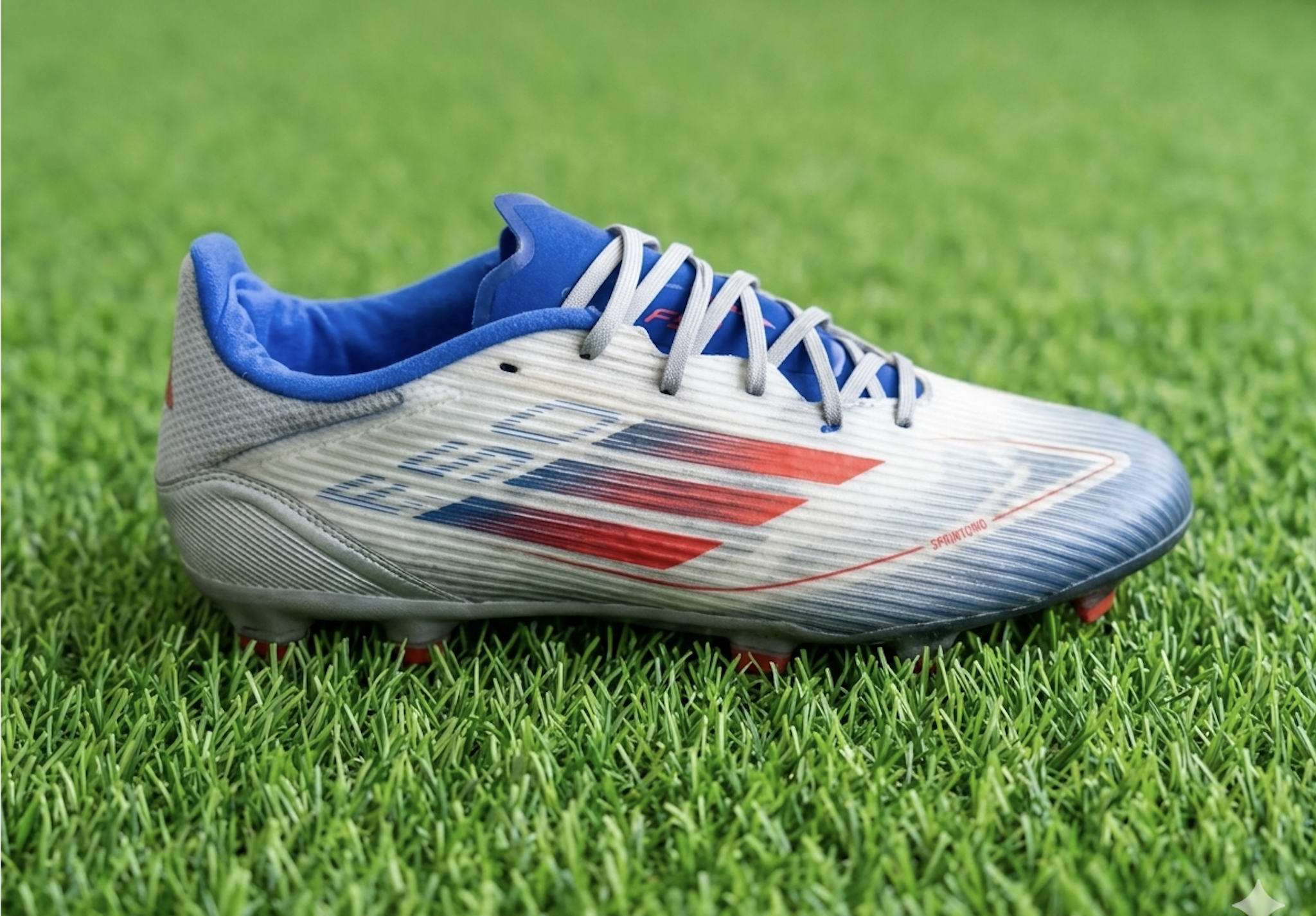
Indoor, Turf, or Grass? The One Thing Every Adult Player Gets Wrong About Soccer Cleats
I own two pairs of soccer cleats. Not because I’m some gear obsessive with a spreadsheet for stud patterns – I own two pairs because I spent a few months pretending one pair could handle every surface, and my knees eventually sent me the invoice.
One pair lives in my bag for the artificial turf game. The other comes out for the grass pitch. And the single biggest mistake I see from people just getting back into soccer as adults isn’t buying the wrong brand or the wrong size – it’s buying one pair of boots and wearing them on every surface, then wondering why their knees hurt, why they keep slipping, or why a $100 pair fell apart in four months.
So before you spend a cent on boots, the question to answer isn’t “which boots are best.” It’s “what am I actually playing on?” Get that right and everything else gets easier.
The letters on the box actually mean something
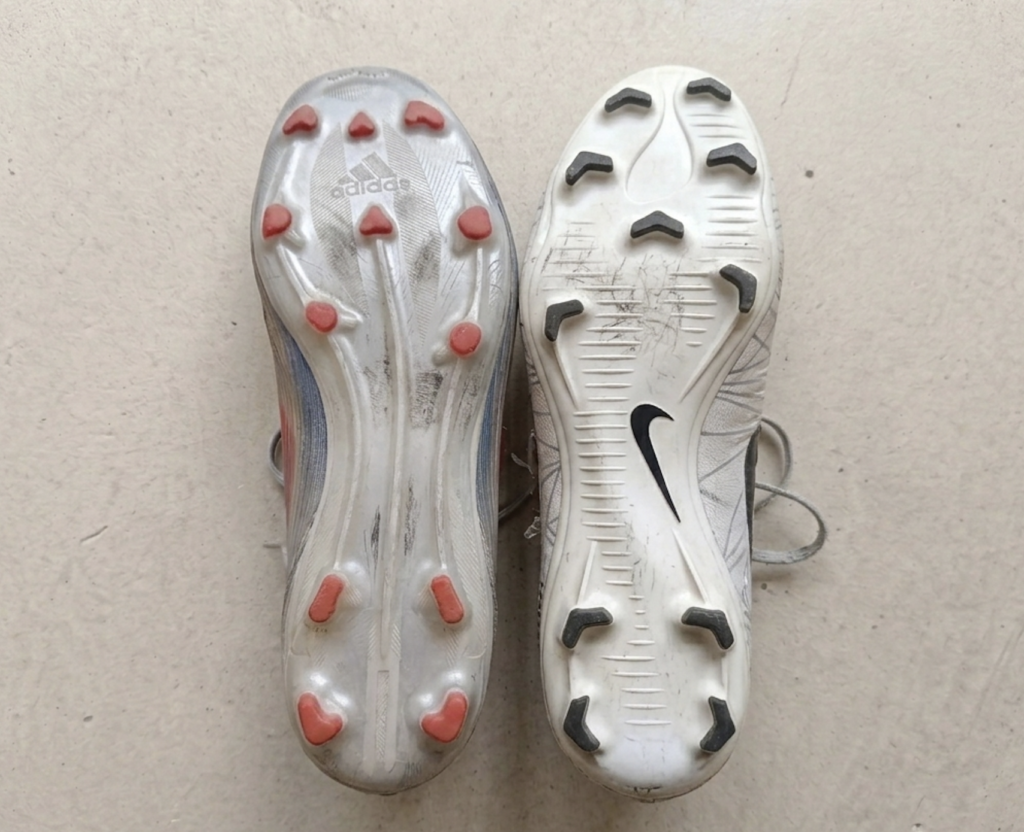
When you shop for boots you’ll see two-letter codes – FG, AG, TF, SG, IC, MG. They look like marketing noise. They’re not. Each one tells you what surface the boot is built for, and matching that to your pitch matters more than the brand on the side.
Here’s the plain-language version.
Indoor and futsal: flat soles, no studs at all
If you play indoors – a gym, a futsal court, an indoor court, anything with a hard flat surface – you don’t want studs at all. You want a flat rubber sole, basically a grippy sneaker. These are labelled IC (indoor court) or sometimes IN.
The logic is simple: there’s nothing for a stud to dig into. On a hard floor, studs just lift your foot off the surface, kill your grip, and feel awful. A flat rubber outsole gives you grip through contact area instead, the same way a basketball shoe does. They’re also the most comfortable boots to wear for long stretches because there’s no pressure point poking up into your foot.
If your soccer is mostly five-a-side on a hard court, this is your pair. Don’t overthink it.
Artificial turf: short rubber nubs (this is where most people go wrong)
This is the one that catches everybody out, and it’s the one I care about most because I spend half my football week on turf – and because I once tried firm-ground studs on it and nearly redecorated the surface with my face.
Artificial turf – the green carpet-style surface, the 3G and 4G pitches most of us actually play our weeknight games on – needs TF (turf) shoes or AG (artificial ground) cleats. If you’ve ever searched “soccer cleats for artificial grass” and ended up more confused than when you started, this is the section that sorts it out. The short version of AG vs FG: AG studs are shorter and more numerous, FG studs are longer and built to bite into soil.
Turf shoes have a rubber outsole covered in lots of small, low nub-like studs. AG cleats have a higher number of shorter studs, often hollowed out so they compress on impact. Either way, the principle is the same: short and many. Lots of little contact points spread your weight across the surface. The catch is that some turf shoes are basically indoor sneakers with a stud rash, while others actually cushion the impact – and after 90 minutes on a hard 3G pitch, your feet will tell you exactly which kind you bought.
Here’s why this matters, and it’s not just performance – it’s your joints. If you wear long firm-ground studs on artificial turf, the studs can’t penetrate the surface. Instead they grip and stick, and your foot stops dead while your body keeps turning. That twisting force goes straight into your ankle and knee. It’s one of the most common ways adult players pick up non-contact injuries, and it’s completely avoidable. Here’s the cruel part: you usually don’t feel it during the game. You feel it later, when you’ve parked the car, turned off the engine, and discovered you can’t actually get out of it. The shorter, more numerous studs on turf and AG shoes let your foot release and rotate naturally.
My turf pair is exactly this kind of shoe, and it’s the right tool for the job. It’s not a cheaper version of a “real” boot – it’s a different boot, built for a different surface. I wouldn’t take it onto wet grass any more than I’d take my grass boots onto the turf.
Firm-ground grass: molded studs, the classic look
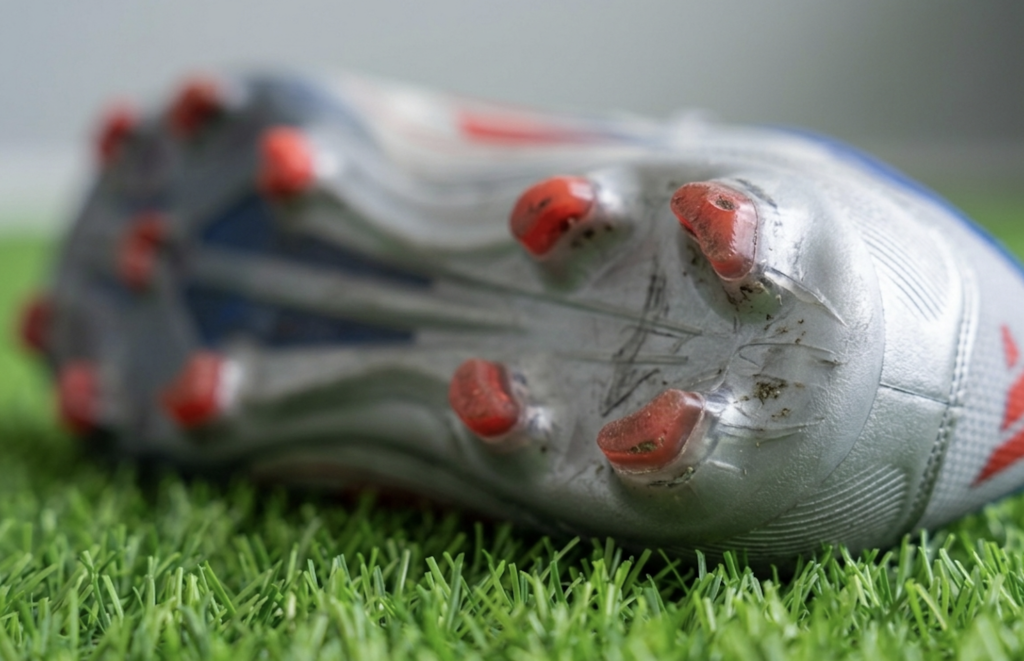
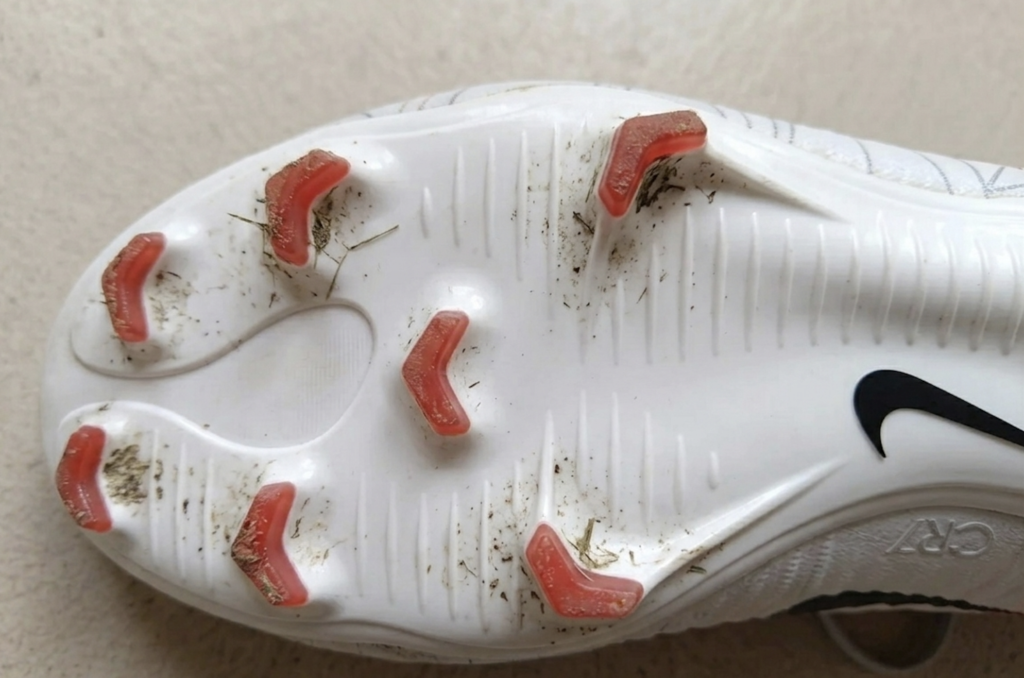
When people picture “soccer cleats,” they’re picturing FG (firm ground). These are the traditional boots for natural grass that’s dry or only slightly damp – the kind of pitch you get most of the year. Flip them over and you’ll see ten to fourteen molded studs, usually a mix of bladed and conical shapes, built right into a stiff soleplate. They don’t come off.
These studs are longer than turf nubs because they’re meant to bite into soil that has a bit of give. That bite is what gives you the grip to plant and sprint and cut on grass. It’s a great feeling on the right surface – and a bad idea on the wrong one.
One important correction to something you’ll hear a lot: standard firm-ground studs are molded plastic, not metal. People often say “metal studs are for grass,” and that’s only half right. Metal studs belong to a different category entirely.
Soft, muddy grass: metal screw-in studs (the ones people mean by “metal cleats”)
If you play on wet, muddy, churned-up grass – winter pitches, heavy rain, badly drained fields – that’s SG (soft ground). SG boots have six to eight longer metal studs that screw in, so the extra length can dig through the mud to find solid ground underneath.
This is the only category where metal studs are normal, and the same rule applies in reverse: never wear them on firm ground or turf. On a hard surface those long studs are painful, slippery, and a fast track to a tweaked knee.
Honestly, though? Most adult rec players never need SG boots at all. If your grass games are on decent, dry-to-damp pitches, firm ground is your answer and you can skip this whole category.
“Can I just buy one pair for everything?”
Short answer: not really. And this is the honest version the gear shops don’t always lead with, because “buy one pair” sells fewer boots than “buy the right boot.”
There are compromise boots out there – you’ll see them labelled multi-ground, designed to be acceptable on a couple of surfaces at once. The problem is right there in the word “acceptable.” A do-it-all boot is shorter on grip than a real grass boot and harder on your feet than a real turf shoe. It does two jobs at sixty percent each instead of one job properly. You stop noticing the compromise until the night you really need grip and it isn’t there.
If you genuinely only ever play one surface, buy the boot built for that surface and you’re done. If you play two surfaces regularly – turf one night, grass the next, which is exactly my week – the honest answer is two pairs. Not because gear shops want your money, but because each pair does its one job properly and lasts longer doing it. I run two pairs and I wouldn’t go back to fighting one set of studs across surfaces they were never built for.
What you should not do is buy a pure firm-ground boot and wear it on turf because “studs are studs.” That’s the football equivalent of “all tires are the same,” and it’s the mistake that costs you grip, comfort, and sometimes a knee.
The quick cheat sheet
Here’s the whole article in six lines. Screenshot this part.
- Indoor court / futsal → flat rubber sole, no studs (IC / IN)
- Artificial turf → short rubber nubs (TF) or short hollow studs (AG)
- Dry to damp natural grass → molded plastic studs (FG)
- Wet, muddy natural grass → longer metal screw-in studs (SG)
- Splitting your week between two surfaces → a purpose-built pair for each
- Wrong studs on the wrong surface → worse grip, faster wear, higher injury risk
Three mistakes adult players make with cleats
If you take nothing else from this, avoid these three. They’re the ones I see over and over – and the first one I made myself.
1. Wearing firm-ground studs on artificial turf. The big one. The studs can’t sink in, so they grab and stick, and your joints pay the difference. This is the turf-vs-firm-ground cleat mistake that sends rec players to physio.
2. Buying boots a size too tight because “they’ll stretch.” Some leather uppers give a little. Most modern synthetic and knit boots barely stretch at all. A boot that’s painful in the shop is a boot that’s painful in month six. Buy for the foot you have, not the foot you’re hoping to break the boot into.
3. Using one pair for every surface, all year. Turf one night, grass the next, indoor in winter, same boots for all of it. It’s the most expensive kind of saving money – you wear the pair out faster and you play worse on every surface. The fix isn’t one clever pair that does everything. It’s owning the right shoe for the surface you actually play on most, and a second pair only if you regularly play a second surface.
So what should you actually buy?
Start with your surface, not your budget and not the brand. Your teenage self could get away with playing on whatever boots were in the bag. Your current knees are less forgiving and they keep the receipts. Figure out where you play most often, buy the boot built for that surface, and only then start thinking about fit, comfort, and how much you want to spend. A $60 pair that matches your pitch will serve you better than a $200 pair built for the wrong one.
In the next piece I’ll get into the part everyone rushes – fit and sizing – and walk through specific boots worth looking at in each price range, including the best soccer cleats for turf and grass I’ve actually played in (one pair cost me three times what the other did, and the story there isn’t what you’d expect). For now, just nail the surface question. It’s the one decision that everything else depends on.
Got a surface I didn’t cover, or a stud-pattern horror story of your own? Drop me a message – half the time the answer becomes the next article.